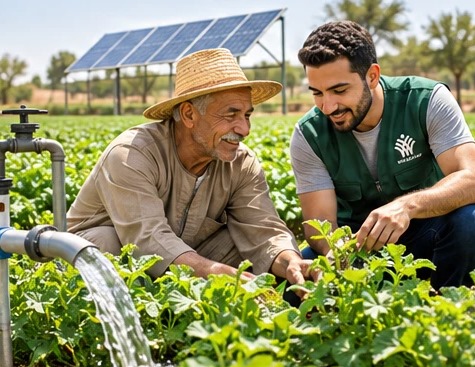
A development and agricultural initiative launched by the National Alliance for Civil Development Work (NACDW) in November 2022 and implemented by the Coptic Evangelical Organization for Social Services (CEOSS) to support smallholder farmers and encourage them to take up and keep growing strategic crops, chief among them wheat.
At a Glance
Target Group
Smallholder farmers in the target governorates
How It Works
Subsidized high-quality seeds, technical support and agricultural extension, and field schools
Partnership
Launched by the National Alliance and implemented by CEOSS, in partnership with the Ministry of Social Solidarity and the Ministry of Agriculture and Land Reclamation
About the Initiative
The initiative combines agricultural development, economic empowerment and social protection: it provides subsidized high-quality seeds, technical support and agricultural extension, and field schools, within a partnership between state institutions and civil society.
Its core idea is to move smallholder farmers from need to production and self-reliance by providing the support, knowledge and resources they need to keep growing strategic crops, helping them improve their productivity and incomes, supporting rural families and contributing to stronger food security.
Challenges the initiative addresses
Smallholder farmers’ need for support that helps them keep growing strategic crops and improve crop quality and productivity.
The burden of production input costs, including seeds.
Raising agricultural productivity, which requires extension, follow-up and technical support alongside seeds.
The gap between needs and domestic production of strategic crops, especially wheat.
Improving the living standards of rural families and their ability to rely on production.
Engaging rural women in productive activities and developing their skills.
Initiative Objectives
Supporting smallholder farmers
Encouraging them to take up and keep growing strategic crops.
Providing subsidized high-quality seeds, technical support and agricultural supervision.
Raising yield per feddan and improving the quality of production.
Improving farmers’ incomes and living conditions.
Strengthening food security
Increasing domestic production of strategic crops and expanding wheat cultivation.
Helping to narrow the gap between domestic production and needs, and to reduce reliance on imports.
Supporting the state’s efforts to achieve self-sufficiency in strategic crops.
Rural development and social protection
Supporting families most in need in rural communities.
Strengthening smallholder farmers’ ability to remain in productive activity.
Linking social protection to economic empowerment and production.
Helping to reduce poverty and deprivation in rural areas.
Empowering rural women
Developing their skills and engaging them in productive activities.
Training in agro-processing and supporting their participation in food value chains.
Diversifying household income sources and improving living standards.
Implementation mechanisms
Providing seeds and production inputs
High-quality, high-yield wheat seeds are made available to smallholder farmers through the outlets of the Central Administration for Seed Production, with financial support that lowers the cost of obtaining them. The support mechanism may vary from one phase to another.
Technical support and agricultural extension
Agricultural guidance for the wheat crop, awareness of good agricultural practices, and technical support and supervision throughout the stages of crop production, drawing on agricultural specialists, so that farmers receive knowledge and guidance alongside production inputs.
Field schools
Hands-on training and guidance in the fields on good agricultural practices for wheat, transferring agricultural knowledge and expertise to farmers and following up on its application to support production efficiency.
Field follow-up
Visits to farmers to follow up on the progress of the growing process and provide the necessary guidance, helping them apply good agricultural practices and deal with challenges that may affect production.
Empowering rural women and agro-processing
Specialized field schools for rural women, along with training in agro-processing and the development of productive skills, to strengthen their participation in economic activities and food value chains, open up opportunities to diversify household income, and support their role in managing natural resources and strengthening food security for the family and the community.
Target Groups and Scope of Implementation
Primary group
Smallholder farmers in the target governorates who need support to help them keep growing wheat and strategic crops.
Groups linked to development interventions
Families most in need in rural communities, including smallholder farming families enrolled in the “Takaful and Karama” program, and rural women through training programs in agro-processing and productive activities. According to the Ministry of Social Solidarity’s announcement in June 2025, 18% of the smallholder farmers taking part in the initiative at the time were from “Takaful and Karama” families.
Target governorates in Phase Five (2026/2027 season)
Beheira, Qalyubia, Dakahlia, Kafr El-Sheikh, Gharbia, Giza, Menoufia, Sharqia, Ismailia, Fayoum, Beni Suef, Minya, Assiut, Sohag, Qena, Luxor, Aswan and New Valley.
Partnerships
National Alliance for Civil Development Work
Launched the initiative as part of its development efforts and coordinates joint efforts between state institutions and civil society to serve smallholder farmers.
Coptic Evangelical Organization for Social Services (CEOSS)
The initiative’s implementing body and a member of the National Alliance; it carries out community, awareness-raising and training activities and delivers services and support to smallholder farmers.
Ministry of Social Solidarity
Supports the initiative through the Rural and Environmental Industries Support Fund and helps link agricultural interventions to social protection.
Ministry of Agriculture and Land Reclamation
Provides scientific and technical expertise and capabilities, helps supply seeds, and takes part in supervision and technical support.
Agricultural Research Center and agricultural experts
Scientific and technical expertise that supports the development of agricultural practices and the improvement of crop quality and productivity.
The four-party cooperation protocol was signed in June 2025 between the Ministry of Social Solidarity, represented by the Rural and Environmental Industries Support Fund; the Ministry of Agriculture and Land Reclamation; the National Alliance; and CEOSS. The Agricultural Research Center and the experts take part in technical and scientific support and are not parties to the protocol.
Initiative phases and latest developments
The initiative was launched in November 2022 and has expanded through successive phases. Each figure below is tied to its phase and to the date it was announced.
The first three phases: from November 2022 to the 2024/2025 wheat season
According to the Ministry of Social Solidarity’s announcement in May 2025:
Aimed to support and encourage nearly 500 thousand smallholder farmers.
Work extended to 16 governorates.
Contributed to the cultivation of nearly 780 thousand feddans.
Focused on encouraging farmers to grow strategic crops, chief among them wheat, and to keep growing it.
Phase Four: 2025
Launched with the signing of a four-party cooperation protocol in June 2025. The Ministry of Social Solidarity’s announcements about it included:
Cultivating one million feddans of wheat as the phase’s strategic goal, while working to increase productivity (an announced target, not a final result).
Financial support covering 50% of the price of seeds for smallholder farmers, provided by the Rural and Environmental Industries Support Fund.
Providing high-yield seeds, delivering technical support and running field schools.
A focus on empowering rural women.
Phase Five: 2026/2027 season
The technical structure of the initiative’s experts was launched in November 2026 in preparation for the wheat-planting season. The phase’s targets include:
Working in 18 governorates and reaching 120 thousand farmers.
Targeting the cultivation of 300 thousand feddans of wheat.
Running 115 specialized field schools for rural women, focused on agro-processing.
Providing high-yield seeds at a subsidized price, technical support, field schools on good agricultural practices for wheat, and field follow-up visits.
A technical and administrative structure comprising 750 community volunteers, 350 agricultural engineers and graduates of faculties of agriculture, and 50 experts from faculties of agriculture and the Agricultural Research Center.
According to the same announcement (November 2026), the previous phases reached about one million feddans and 620 thousand farmers, a cumulative update that differs from the figures announced in May 2025.
Impact of the initiative
The impact the initiative seeks to achieve, as described by official bodies. It is a targeted impact and does not mean it has been achieved in full or to the same degree in every governorate.
For farmers
Better opportunities to keep growing strategic crops.
Easing part of the cost of seeds through the support announced in some phases.
Better agricultural knowledge and skills, and higher production efficiency and crop quality.
Improved income and living standards.
For families
Supporting rural families most in need.
Moving from reliance on aid to participation in productive activity.
Diversifying income sources through productive activities and agro-processing.
Supporting women’s participation in economic activity.
For rural communities
Spreading knowledge and good agricultural practices.
Strengthening cooperation between government institutions and civil society.
Supporting rural development and improving production opportunities.
Strengthening the role of rural women in the community.
For food security
Supporting increased domestic wheat production.
Helping to narrow the gap between domestic production and needs, and to reduce reliance on imports.
Supporting the state’s drive to strengthen food security.